
From enterprise AI pilots to production · Python 3.10+
Agents that deliver
business results
Models can understand and generate. Business systems still need typed fields, permissioned actions, workflow lifecycle, service APIs, and run evidence. Agently connects those production gaps into one verifiable engineering chain.
Install
pip install -U agently
Enterprise agent engineering chain
Agently is not just another agent framework. It fills the gaps that block production.
Enterprise AI projects often fail at four boundaries: unstable system data, tool calls without control, long flows without traceability, and post-launch runs without evaluation. Agently turns those risks into capabilities teams can validate layer by layer.
Turn language into downstream data
Output schema, result facade, instant stream, and validation make fields usable by UI, tickets, CRM, audit, and later workflow steps.
Let agents act without overreach
Actions, Function Calling, MCP, and ExecutionEnvironment put tools and scripts behind explicit owners, records, and permission boundaries.
Run long tasks with events and branches
TriggerFlow and Dynamic Task support sequence, parallelism, conditions, waits, resume, runtime stream, and execution snapshots.
Observe, evaluate, and iterate after launch
FastAPIHelper, RuntimeEvent, Workspace, DevTools, and update policy let teams operate AI agents as products.
Capability stack
From one request to production workflows
Start with structured results, add external tools, then service and observe the workflow. Each layer has documentation and runnable examples.
Request
Stable output
Deliver model results as typed fields and streaming patches.
RuntimeActions
Connect functions, MCP, sandboxes, and business systems.
WorkflowTriggerFlow
Event-driven branches, parallel work, pause/resume, and runtime streams.
DAGDynamic Task
Validate and execute task graphs submitted by apps or generated by models.
Dev SuiteAgently-DevTools
Put observation, evaluations, playground, and logs in one local console.
Build SuiteAgently-Skills
Help coding agents decompose and generate complex AI applications.
Agently-Skills · Official tooling for coding agents
Turn one sentence into a deliverable AI application
Agently-Skills is not the framework-side Skills Executor. It is the official guidance package for Codex, Claude Code, Cursor, and other coding agents. The current public catalog has 6 installable skills aligned with the Agently 4.1.3 runtime line, so a coding agent can start from a business goal and choose the right request, runtime, orchestration, Dynamic Task, or migration path.
Current public catalog: 6 skills
Aligned with Agently 4.1.3 runtime
Install app bundleLet your coding agent follow Agently's official boundaries
export AGENT=codex

for skill in \
  agently \
  agently-request \
  agently-runtime \
  agently-dynamic-task \
  agently-triggerflow
do
  npx skills add AgentEra/Agently-Skills \
    --agent "$AGENT" --skill "$skill" -y
done

# migration path
npx skills add AgentEra/Agently-Skills \
--agent "$AGENT" --skill agently-migration -y"Build a support-ticket triage agent with severity, owner, next_step, and a create-ticket action."
- Use `agently-request` for structured output.
- Use `agently-runtime` for controlled Actions.
- Generate the service entry, test inputs, and validation checklist.
"Split daily news automation into outline, search, pick, summarize, render, and expose SSE."
- Use `agently-triggerflow` for staged and parallel nodes.
- Stream runtime progress to the frontend.
- Deliver an editable Markdown report artifact.
"Move a LangGraph tool-calling flow to Agently while preserving tool boundaries and run evidence."
- Use `agently-migration` for layer mapping.
- Move tool calls into Actions / MCP / ExecutionEnvironment.
- Add DevTools observation and regression checks.
Agently-DevTools · Local observation, evaluation, and playground
Make every agent run inspectable
agently-devtools is Agently's optional companion package. In development and staging, ObservationBridge connects Runtime Observation, Scenario Evaluations, Playground, Console, and Logs in one local console. Your Agently app can still run without it.
- Run tree, graph, Mermaid, and trace help teams locate workflow paths.
- EvaluationBridge connects repeated scenario evaluations with real runs.
- Playground validates model settings, output contracts, and prompt variants.
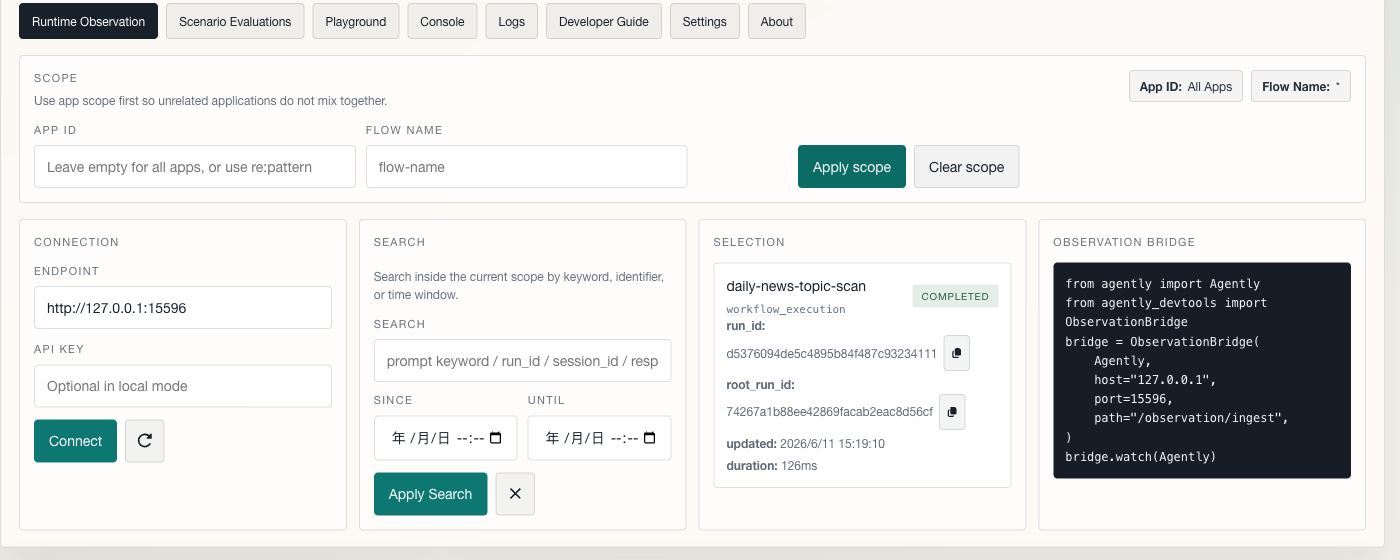
pip install -U agently agently-devtools
agently-devtools start
ObservationBridge(Agently).watch(Agently)
Real deliverables
Show the business artifact, not just the framework promise
These examples have working evidence: screenshots, generated reports, interfaces, or local prototypes that can be decomposed into APIs, workflows, data contracts, and runtime evidence.
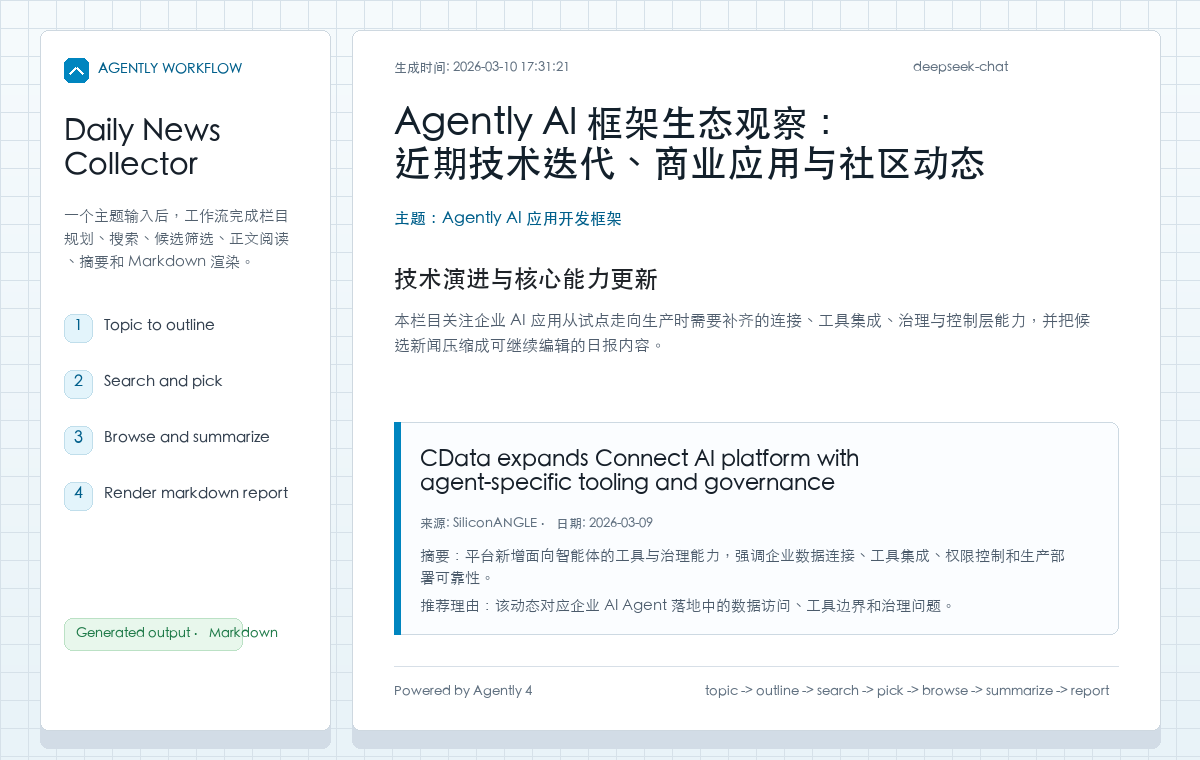
From one topic to an editable Markdown report
For market, research, operations, and risk teams that need repeatable news collection and report generation.
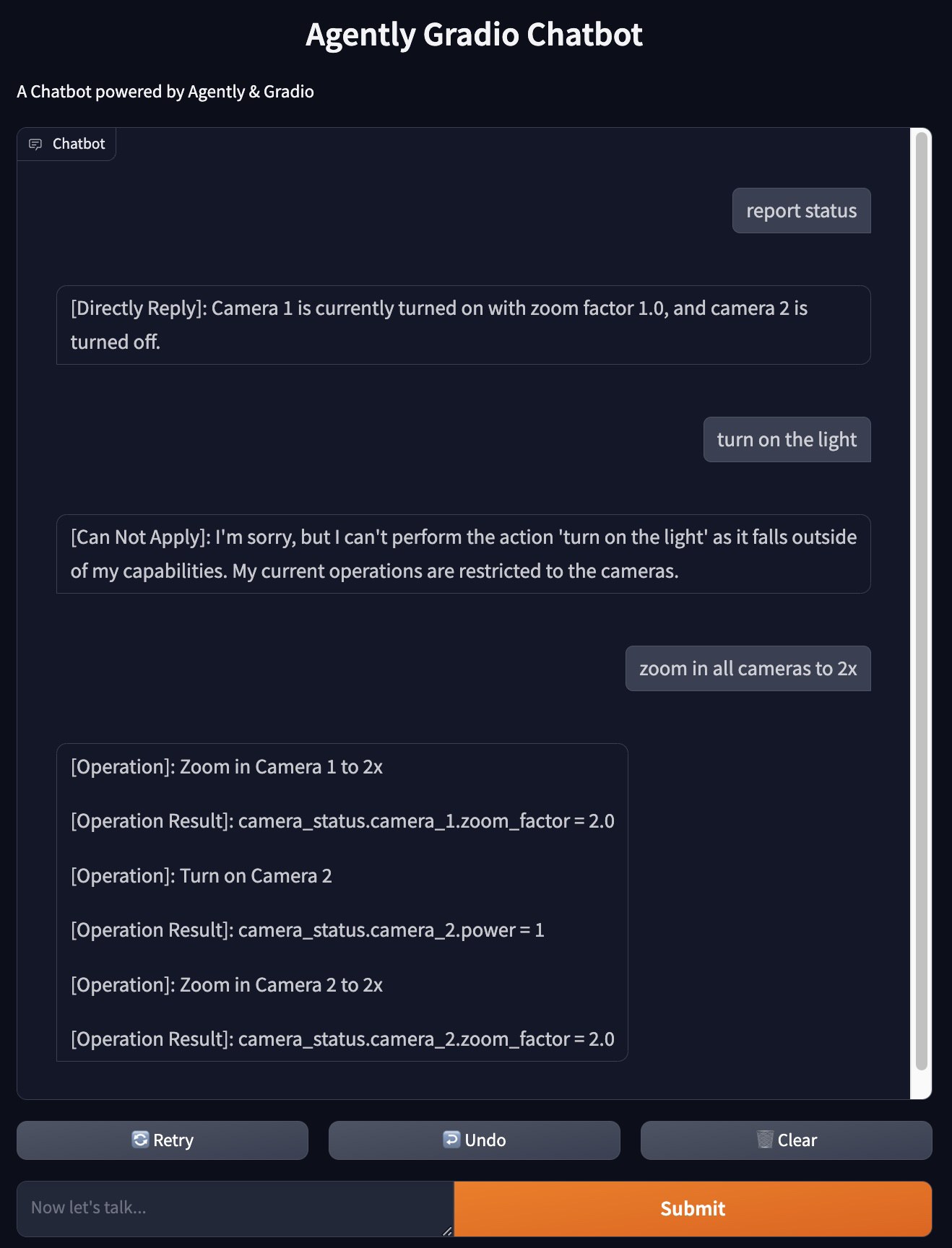
Operate business objects with natural language
The system reads state, plans actions, executes or refuses, and sends runtime feedback back to the UI.
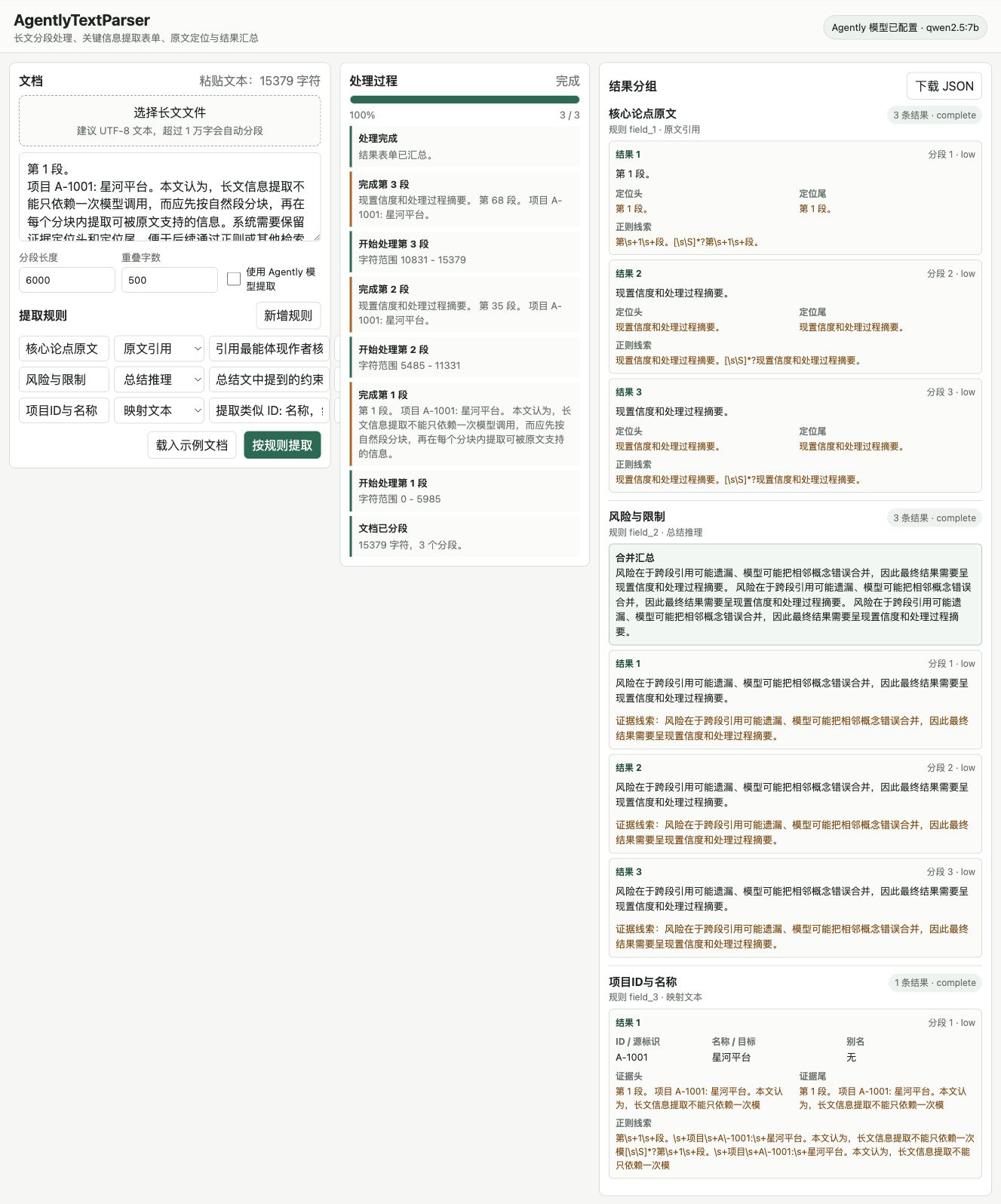
Long-text extraction with grouped fields and evidence
Contracts, reports, interviews, and knowledge assets can become exportable JSON or forms with source references.
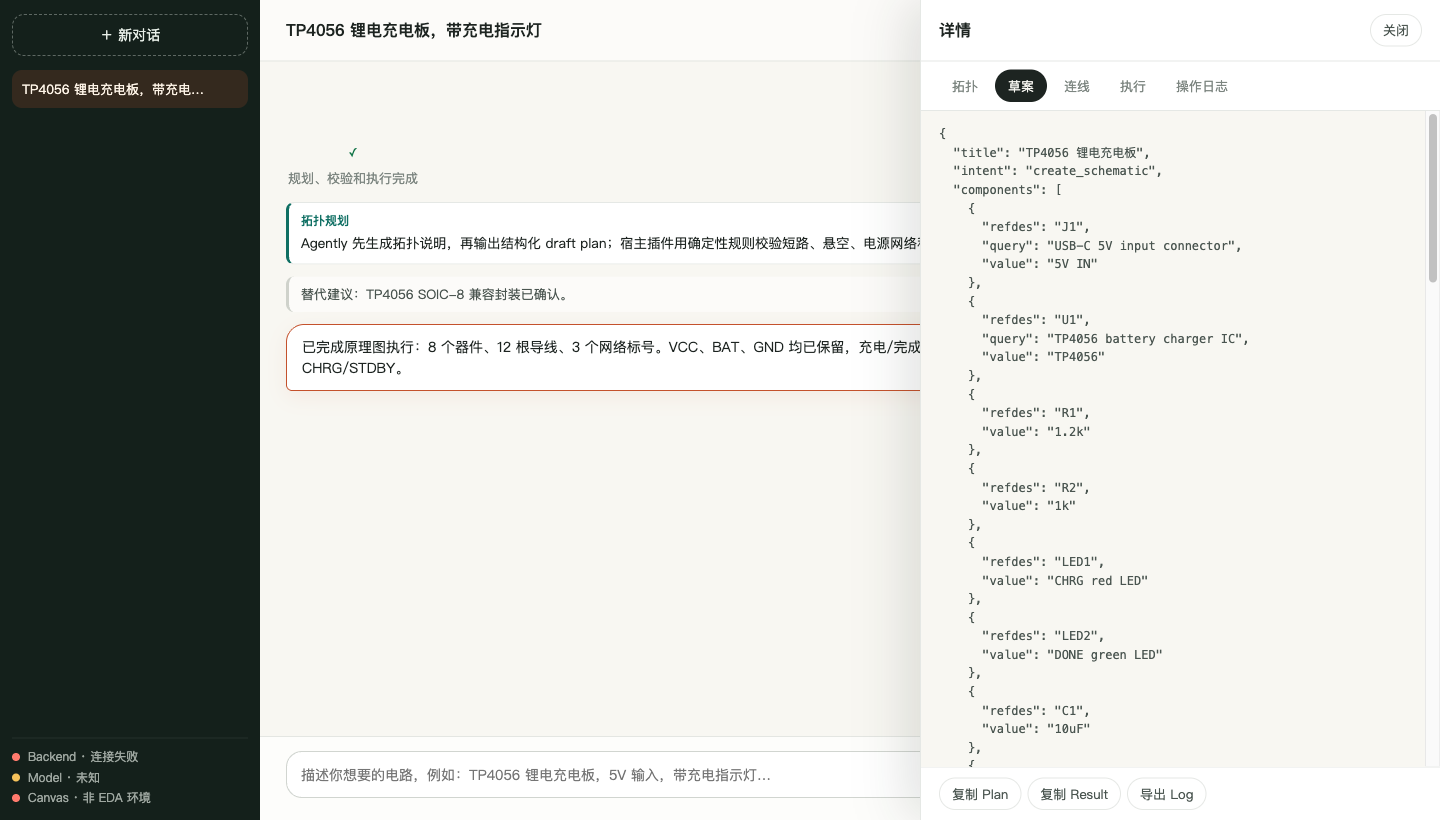
From expert requirements to tool execution
The model drafts a structured plan while the host system validates hard rules, chooses alternatives, and calls tool APIs.
Repository examples · verifiable cases
Use real runs to explain customer value
These are not one-off website demos. They come from the Agently repository examples and keep stable key outputs, so teams can inspect what was generated, who can use it, and which engineering chain Agently supplies.
Generate a sendable duplicate-charge reply and verify policy compliance
View full codetask_status="completed"
accepted=true
output_file_exists=true
model_judge_passed=true
replan_count=0For support and billing teams: business systems provide invoices and policy facts, the agent writes the Markdown reply, and the judge checks that it does not invent facts or promise a refund before finance review.
Turn incident logs and status feedback into a customer-success briefing
View full codesummarize_facts
-> assess_customer_impact
validated TaskDAG
planned_task_count=3
semantic_role=customer_success_briefing
write_customer_success_briefing
frontstage_next_update=when duplicate payment verification completes
status_banner="Latency status: resolved. Duplicate payment checks: running."For customer success and operations: the model plans the DAG, the status system supplies facts, and the final artifact is a briefing an account owner can use.
Synthesize sales, product, support, and legal signals into a recovery package
View full codeplanned_task_count=6
root_task_count=3
join_task_count=1
semantic_role=recovery_package
next_actions_count=7For strategic accounts: CRM, usage, P1 support, commercial asks, and legal blockers are analyzed in parallel, then joined into customer messaging and internal next actions.
MCP and sandbox execution make model actions recordable and reviewable
MCP code Sandbox codeMCP calculator -> 168.21
Python sandbox -> average=20.0, gap=34
ActionResult -> model_digest + artifact_refsFor tool-using systems: the model chooses the call path, MCP and sandbox execution do the deterministic work, and ActionResult keeps the evidence.
Partnership, license, and careers
Clear entry points for business, engineering, and candidates
Use public docs, project evidence, and local trials to validate the technical path. For commercial license, trademark/certification statements, or careers, use the corresponding entry point.
PerfXCloud x Agently
Public practice around cloud services, model application runtime, and enterprise AI engineering.
Developer community
Discuss business-system integration, tool governance, TriggerFlow orchestration, service delivery, and DevTools observation.
Join WeChat groupLicense statement
Agently open-source core uses Apache 2.0. Trademark, official certification, partner, or endorsement claims are not automatically granted by the open-source license. Contact business@agently.tech for commercial authorization.
Join us
We keep openings for full-stack application engineers, full-stack product managers, and technical operations/business roles. Send your resume to hr@agently.tech.
ApplyStart validating
The shortest path for engineering teams
Run one structured request first, then connect actions, workflows, services, and observability. Each step has a matching doc page.